Seeking to bridge the gap between local vulnerabilities and global solutions, Mindoro State University (MinSU) has advanced its efforts toward positioning the Philippines as a regional hub for climate resilience by convening an international network of scientists, engineers, researchers, and policymakers focused on addressing the unique environmental and economic challenges faced by island communities.
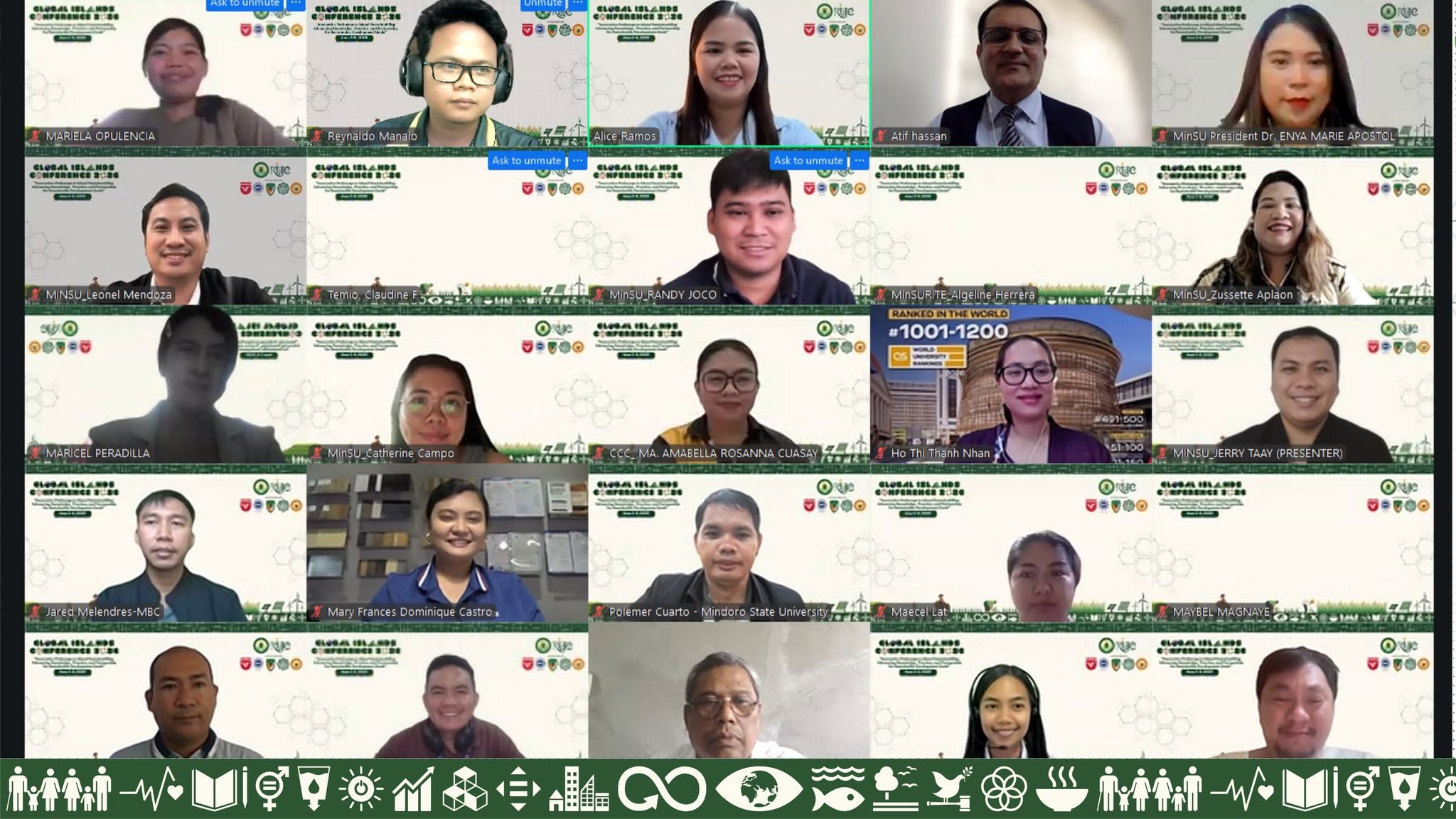
Through its Research, Innovation, Technology, and Extension (RITE) Office, MinSU officially launched the Global Islands Conference (GIC) 2026 held virtually on June 5, 2026, bringing together experts and institutions from across Asia and beyond in a high-level virtual summit.
With the theme, “Innovative Pathways to Island Sustainability: Advancing Knowledge, Practice, and Partnership for Sustainable Development Goals,” the conference served as a platform for collaborative research, knowledge exchange, and innovative solutions aligned with the United Nations Sustainable Development Goals (SDGs).
According to Prof. Leonel C. Mendoza, OIC-Vice President for RITE, GIC 2026 was envisioned as a strategic avenue for cross-border knowledge transfer, enabling vulnerable island ecosystems such as Oriental Mindoro and other island provinces to access evidence-based approaches to climate adaptation, environmental protection, and sustainable economic development.
Four distinguished international experts delivered plenary presentations highlighting practical and scalable strategies that can be adapted by island communities worldwide.
Prof. Dr. Atif Hassan, Dean of the School of Professional Advancement at the University of Management and Technology in Pakistan, discussed sustainable hospitality leadership and emphasized ecotourism models that balance economic growth with environmental stewardship.
Meanwhile, Dr. Hồ Thị Thanh Nhàn of the Arts and Design Faculty of Van Lang University in Vietnam shared innovative approaches to eco-friendly interior design and architecture that promote sustainability while preserving cultural heritage.
Dr. Doris Ifeoma Ogueri, an environmental scientist from Shinawatra University in Thailand, presented insights on environmental governance, international sustainability policies, and resource management strategies that can strengthen community resilience.
Providing an engineering perspective, Dr. Arlan P. Beltran, a Chartered Professional Engineer based in Doha, Qatar, discussed resilient infrastructure systems and construction approaches capable of withstanding increasingly severe weather events linked to climate change.
Recognizing that sustainable development requires collaborative governance and multidisciplinary partnerships, MinSU strengthened its international engagement through collaborations with higher education institutions (HEIs), including the University of Management and Technology in Pakistan, Van Lang University in Vietnam, and Shinawatra University in Thailand.
Moreover, to ensure that global knowledge and innovations are translated into local action, the University also partnered with regional academic institutions, namely the City College of Calapan (CCC) and the Divine Word College of Calapan (DWCC), fostering a broader network of stakeholders committed to island sustainability.
In a statement, VP Mendoza underscored MinSU's pride in spearheading a global initiative that places island communities at the center of sustainability discussions.
“Through the Global Islands Conference, MinSU gives voice to island realities, resilience, and innovations on a global stage,” VP Mendoza said. He added that the knowledge generated from the conference will not remain within academic circles but will be translated into extension programs, research initiatives, and policy recommendations that directly benefit and improve the lives of island communities, particularly those in Oriental Mindoro and the MIMAROPA region.
He further emphasized that the partnerships established through GIC 2026 are intended to create long-term networks for research collaboration, capacity-building, technology transfer, and sustainable development initiatives addressing shared challenges among island communities.
“The goal is to build lasting, action-oriented collaborations that go beyond ceremonial agreements and instead generate innovative solutions for climate resilience, environmental sustainability, and inclusive economic growth. We envision a global network that advances joint research, innovation, and community development to create sustainable and resilient futures for island communities,” he said.
The conference is expected to produce research outputs, policy recommendations, and collaborative initiatives that will assist local government units (LGUs) throughout the MIMAROPA Region in developing data-driven plans for environmental protection, climate adaptation, and inclusive socio-economic development. (jdtdc)
#SDG9 #SDG11 #SDG13 #SDG17

302 Staff

10531 Students

9 Colleges

3 Years