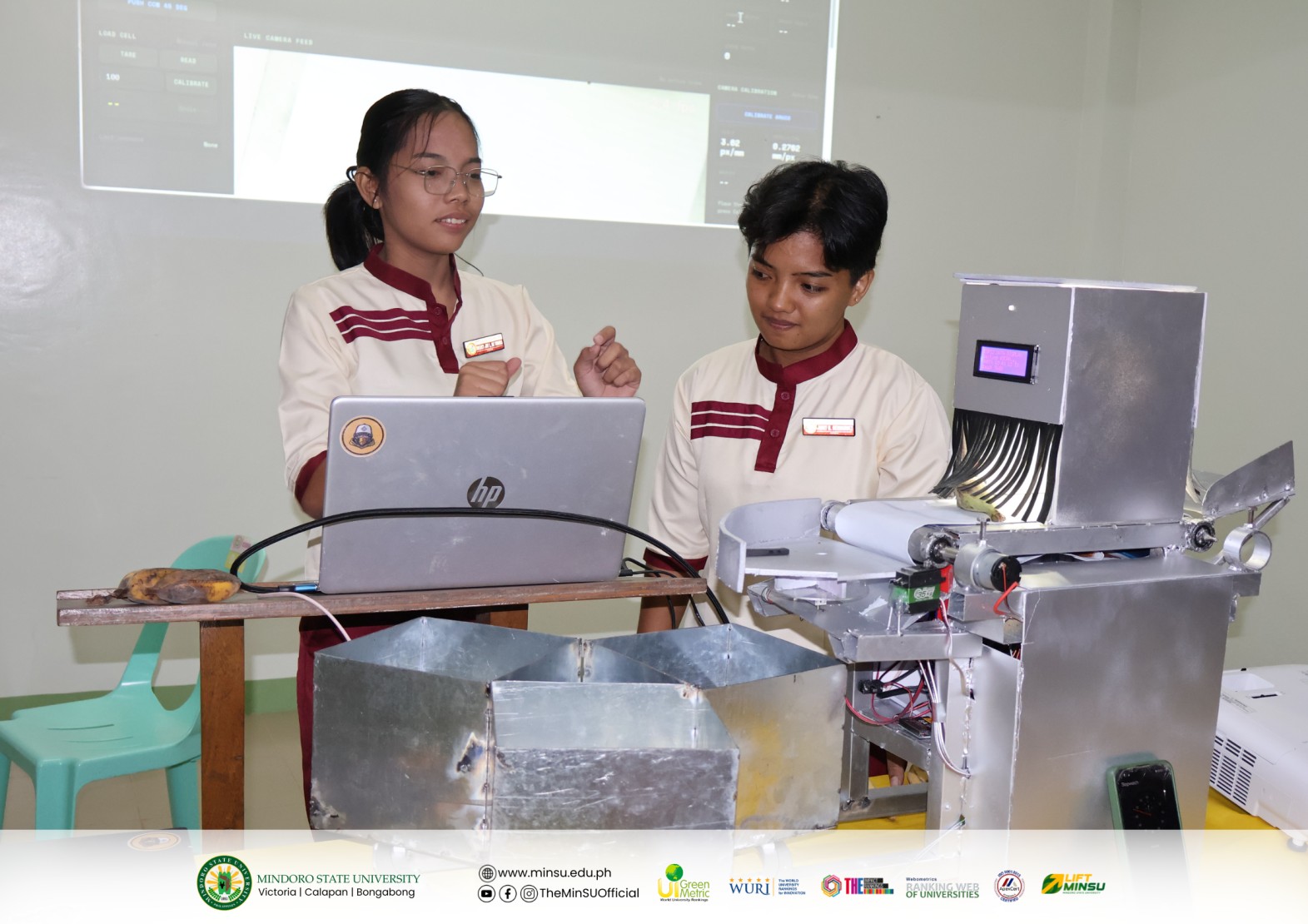
Aiming to bridge the gap between classroom theory and address the persistent issue of postharvest losses in the country, third-year Agricultural and Biosystems Engineering students at Mindoro State University (MinSU) presented eight homegrown agricultural innovations during the MATTECH 2026: ABP 32 Innovation Exhibit held yesterday, June 1, 2026 at the ASTEER Building, MinSU Main Campus.
The exhibit, themed "Harnessing the Properties of AB Materials to Develop Innovative Postharvest Technologies for Sustainable Agricultural Development," challenged student groups to design practical, low-cost machinery utilizing physical and thermal properties of agricultural materials which answers three core criteria: identifying a specific agricultural issue, proving engineering innovation, and ensuring realistic adoption potential for everyday farmers and agri-processors.
The initiative comes amid recurring market gluts across the country. Engr. Randy A. Joco, Director for Innovation and course instructor, noted that tons of vegetables are frequently left to rot in fields due to oversupply, low farmgate prices, and high transport costs.
“Some farmers chose not to harvest their crops because the cost of harvesting and transporting exceeded the income they would receive from selling them,” he said.
Engr. Joco asserted that such economic crises prove that sheer agricultural production is no longer a complete metric for success. “The challenge is not only growing food but also preserving its quality, reducing losses, improving storage and ensuring that agricultural products reach the market efficiently,” he added.
Engr. Mark Keylord S. Onal, OIC Institute Head of the Institute of Agricultural and Biosystems Engineering (IABE), lauded the student cohort for converting academic concepts into sustainable agricultural tools. “These are the collective knowledge you have gained all throughout your stay here, that you have come up with innovations and post-harvest technologies,” Engr. Onal stated.
Jefferson Velasco, one of the student innovators, emphasized that the prototypes were built specifically with smallholder farmers in mind.
"From classroom theory and literature, the prototyped technology we developed is user-friendly and can be used by our farmers to protect their hard-earned yields, prolong the shelf life of their perishable produce, and ultimately prevent the heartbreaking wastage we see during market gluts," Velasco said.
Instead of operating as a mere classroom requirement, MATTECH 2026 concluded as a direct display of how state university research can deliver tangible, field-ready engineering solutions to bolster countryside food security. (jdtdc)
#SDG4 #SDG9 #SDG12 #SDG2

302 Staff

10531 Students

9 Colleges

3 Years